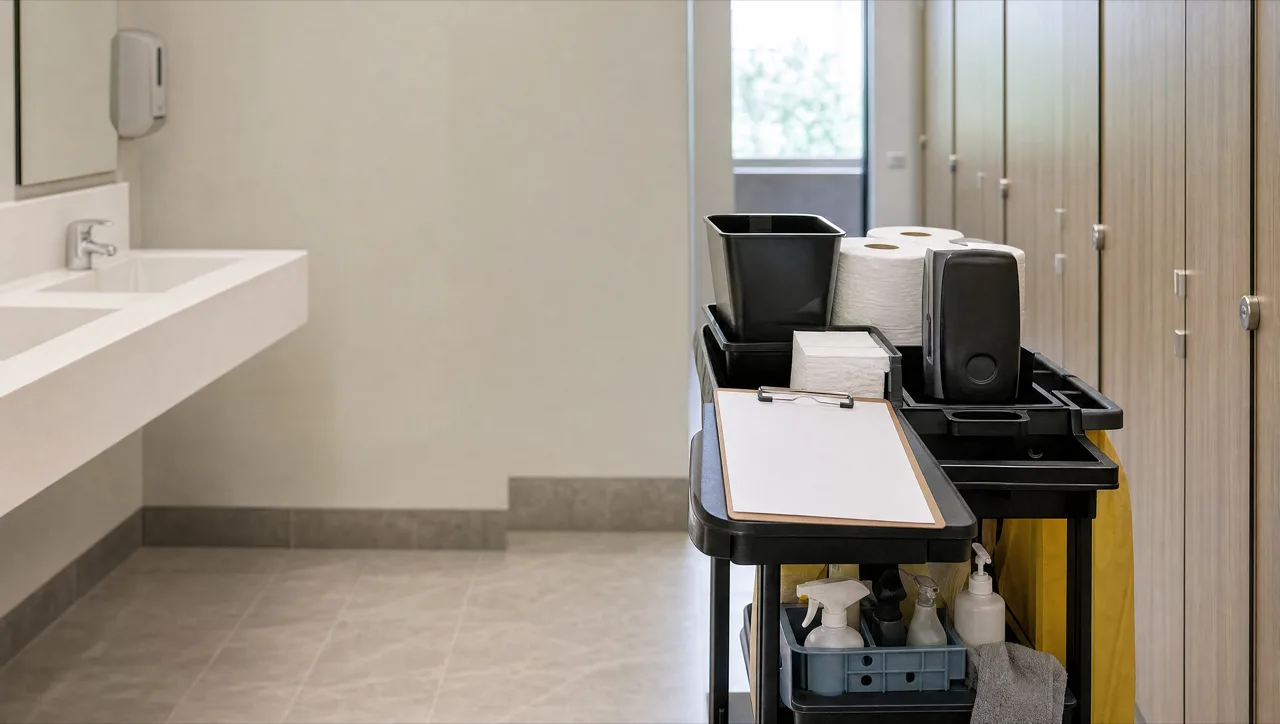
Not every washroom justifies a wall unit. For small offices and single-stall rooms, a stocked kit does the same job at a fraction of the setup. If it's actually maintained.
Key takeaways
- Core kit: two tampon absorbencies, two pad formats, liners, opaque disposal bags, unscented wipes.
- Quality is the credibility line. The cheapest product tells staff what the gesture was worth.
- Baskets suit small washrooms; busy floors need managed dispensers. An empty basket is worse than none.
- Refresh rides the existing service schedule; travel kits and reception stock extend goodwill for cents.
The standard contents: individually wrapped tampons in two absorbencies, ultra-thin pads, and liners, enough variety that no one leaves empty-handed, in a covered basket or cabinet caddy that reads intentional rather than improvised.
Placement mirrors dispenser logic: at the vanity, visible, reachable. Not in a cupboard that requires knowing it exists. A kit nobody can find is a kit that doesn't exist.
Restocking is the failure point. Kits fail quietly. No empty column to notice. Put kit refills on the same documented route as everything else, with fill levels logged, and the quiet failure mode disappears.
When to graduate to a dispenser: consistent daily use, more than one stall, or any compliance obligation. The kit is the right start for a five-person office; it's the wrong endpoint for a fifty-person one.
The core kit, itemised
- Tampons in two absorbencies — regular and super cover the overwhelming majority of needs; single-absorbency kits fail half their users.
- Pads in two formats — a regular daytime pad and a longer overnight format; the second matters for long shifts and travel days.
- Panty liners — the most used and most forgotten item; they outdraw tampons in many workplace kits once stocked.
- Individually wrapped disposal bags — small opaque bags that make any bin, anywhere, usable with dignity.
- A wipes sachet — individually wrapped, unscented. Practical, and signals the kit was assembled by someone who thought about the actual situation.
Quality is the credibility line: a kit stocked with the cheapest possible product tells staff what the gesture was worth. Recognisable quality manufacturers or certified organic lines cost cents more per item and read completely differently.
Sizing and refresh
A kit is a buffer, not a supply program. It bridges the moment of need to the next restock. Size it to the washroom's traffic: a small office washroom does fine with five of each item; a high-traffic floor needs a managed dispenser instead of a bigger basket, because open baskets in busy washrooms empty in days and the empty basket is worse than none. Refresh on the same logged schedule as the disposal service. A technician already in the washroom tops the kit in thirty seconds. And retire products past expiry; tampons carry shelf lives, and a five-year-old kit is a liability pretending to be an amenity.
An empty basket announces the program failed. A managed refill schedule is the difference between an amenity and an apology.
Beyond the washroom
Two placements extend the program where it earns disproportionate goodwill: travel kits for field teams and site visits (a zip pouch in the vehicle kit, refreshed quarterly), and a small stock at reception or first-aid stations for visitors. A guest caught out remembers the building that handled it well. Both cost almost nothing against the program's existing supply line, and both are the kind of detail that shows up unprompted in workplace reviews.
Kits as the entry point to a real program
Most organisations do not start with dispensers. They start with a basket someone assembled after an awkward moment, and the basket becomes the pilot nobody named. Used deliberately, that sequence works well: run the kit for a quarter, track how often it needs topping up (a sticky note inside the cabinet door is a perfectly good log), and let the refill rate make the case for the next step. A basket refilled weekly is a washroom that needs a dispenser; a basket refreshed monthly can stay a basket. The kit's real value in this sequence is that it converts an abstract program debate into a small observed fact about your own building. And small observed facts win budget conversations that principle arguments lose.
One caution as kits scale: consistency across washrooms starts to matter more than contents. Two identical kits in two washrooms read as a program; a generous kit in one washroom and a bare one in another reads as favouritism nobody intended. When the count of kit locations passes a handful, that consistency burden is precisely the signal that a managed restocking arrangement has become cheaper than the coordinator time now keeping the baskets aligned.
Frequently asked
By traffic. A washroom serving under roughly twenty people runs fine on a refreshed basket. Past that, open baskets empty unpredictably and the empty state does real damage. A managed single-vend dispenser holds more, meters usage, and stays credible between visits.
Yes, typically around five years from manufacture. Humid washroom storage shortens that. A refresh rotation on the service schedule keeps stock inside its life; a set-and-forget kit from three office managers ago does not.