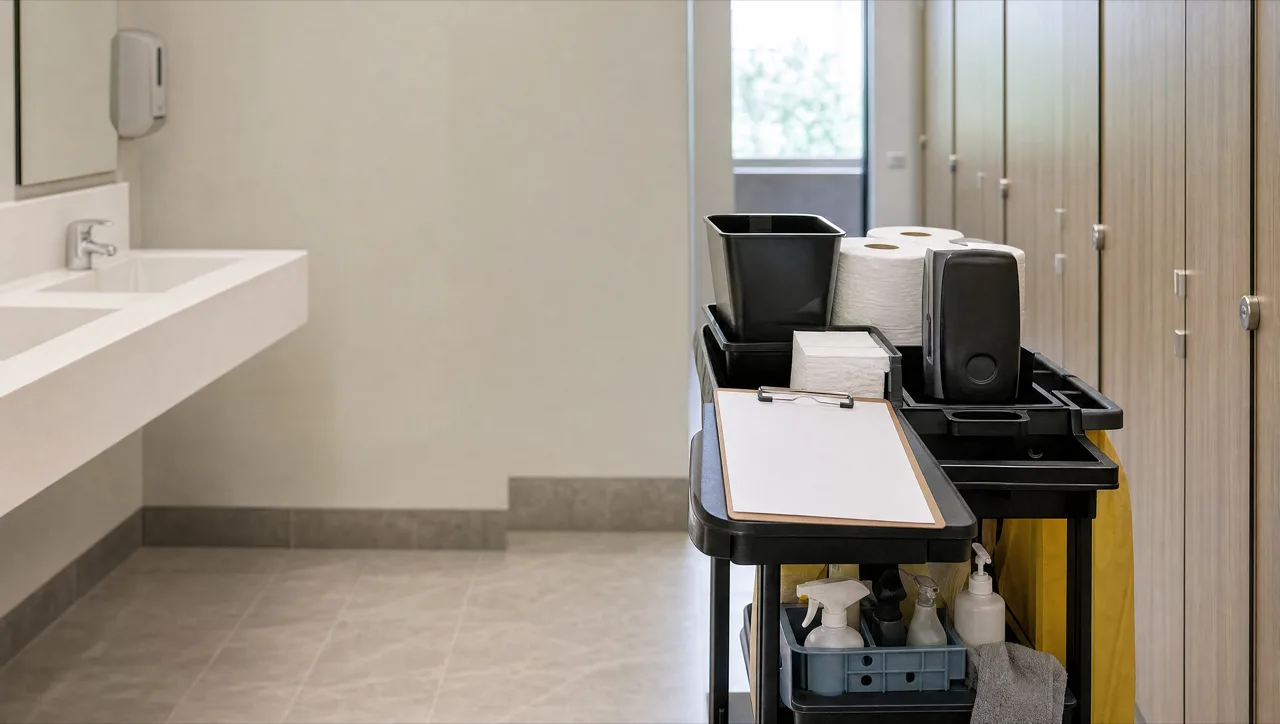
Whether it's a labour-program inspection, an internal audit or a tenant committee with a checklist, washroom reviews converge on the same five checks. Pass them on paper and you pass them in person.
Key takeaways
- Inspectors walk the same path: supplies → fixtures → waste → condition; the last two decide note vs finding.
- Routine beats snapshot, day-of cleanups get discounted, producible service logs get trusted.
- A log converts an incident into an exception; without one, every incident reads as the pattern.
- Quarterly internal audits: check every stall, and close findings with dated fix notes.
1. Are products available, free, in every washroom? Including men's and universal rooms in federally regulated workplaces. An empty dispenser counts as absent.
2. Is there a covered receptacle in each stall? Shared corner bins are the most cited placement failure. One per stall is the expectation.
3. Are units clean and functional? Jammed mechanisms, broken lids and overflow at inspection time speak louder than any policy document.
4. Is there a service schedule? Ad-hoc servicing reads as no servicing. A standing route with a stated frequency is what 'maintained' means.
5. Can you produce the records? Dated, per-washroom, technician-signed logs answer every prior question retroactively. This is the check that decides close calls. And the one facilities without a documented supplier can't pass.
The inspector's actual path through a washroom
Provincial OHS inspectors, public-health officers and internal auditors converge on a nearly identical walk: supplies first (soap, towels or dryer, paper. And increasingly menstrual products where required), fixtures second (function, leaks, hot water), waste third (bins present, covered, not overflowing), condition last (floors, odour, evidence of a cleaning cadence). The whole visual pass takes minutes per washroom. What separates a note from a finding is almost always the third and fourth items, waste handling and the visible signs of routine, because those are the ones that cannot be fixed an hour before the visit.
- Supplies present and stocked — an empty soap dispenser is the fastest note an inspector writes.
- Covered sanitary disposal in stalls — presence, lid function and fill state; overflowing units escalate the tone of everything after.
- Evidence of cadence — a posted or producible cleaning schedule, service tags on units, dated logs. The routine, not the snapshot.
- Menstrual product provision — on federal inspections this is now a checklist line, and provincial regimes are following.
Passing on paper, failing in practice. And the reverse
A washroom can be spotless on inspection day and still generate a finding if no routine can be shown; inspectors have seen day-of cleanups and discount them. The reverse is also true and more useful: a washroom caught on a bad hour, with a producible service log showing the schedule and the exception, usually closes as a note rather than a finding. The log converts an incident into an exception. This is the operating logic behind every documentation habit in this business: inspections judge patterns, and paper is how you prove the pattern.
Inspectors discount what was clearly done for them and trust what was clearly done routinely. The service tag on the bin outweighs the shine on the mirror.
Running your own audit before someone else does
The internal version takes an hour a quarter with a one-page checklist mirroring the inspector's walk. Two additions earn their place: check every stall (external audits sample; internal ones should not. The missed stall is always the one sampled later), and close the loop on findings with a dated fix note, because an internal audit trail that shows problems found and fixed is the strongest posture a facility can present when the external visit eventually comes.
After the visit: reading and answering a report
Inspection outcomes arrive in a vocabulary worth knowing. A note or observation records something seen, expects no response, and matters mainly as the baseline the next visit reads against. A finding or order carries a deadline and expects evidence of correction. And the quality of the response sets the tone of the relationship more than the finding did. The response pattern that closes files: fix the instance, show the routine change that prevents recurrence, and attach the documentation. A finding about an overflowing unit answered with a photo of an emptied bin invites a re-visit; the same finding answered with a revised service schedule and the supplier's amended route confirmation closes, because it answers the question inspectors are actually asking. Not is it fixed, but will it stay fixed.
Repeat findings deserve special fear. A first finding is an event; the same finding twice is a pattern in the inspector's file, and patterns escalate, in follow-up frequency, in tone, and in some regimes in penalty exposure. This is the practical argument for fixing findings at the routine level even when the instance fix would satisfy the deadline: the goal is not closing this visit's file but determining what the next visit finds.
Frequently asked
Three routes: scheduled OHS or public-health visits, complaint-driven visits (an employee or tenant report), and inspections bundled into broader events, accreditation, licensing, insurance surveys. Complaint-driven visits arrive with the least notice and the most focus, which is why the standing routine matters more than visit-day readiness.
In federally regulated workplaces, yes, provision is a Labour Code requirement and appears on inspection checklists. Provincial inspectors increasingly note absence even where not yet mandated, particularly in schools and public buildings, because provincial regimes are converging on the same standard.