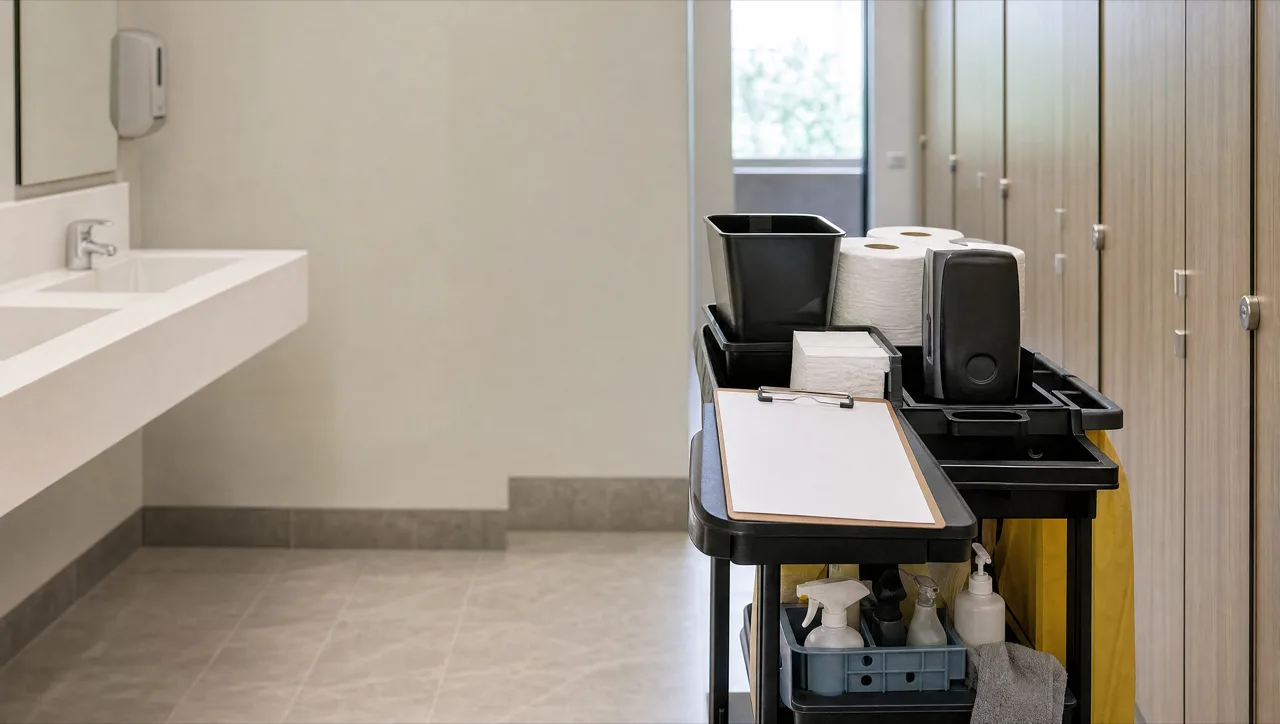
Sanitary waste sits at the intersection of three rule sets: workplace washroom requirements, general waste handling, and plumbing protection. None is complicated. But each has a check an inspector can run.
Key takeaways
- Three layers apply: federal workplace rules, provincial OHS, municipal waste handling, different questions, one routine answers all.
- Inspectors check condition first; when something fails, the service log is what closes the finding.
- A defensible routine: per-stall coverage, named schedule, dated visit records, downstream handling statement.
- Multi-province portfolios: build to the strictest standard once instead of tracking fifty minimums.
Washroom requirements. Federally regulated workplaces must provide covered disposal receptacles in every washroom alongside free menstrual products. Provincial workplace codes express the same idea as a duty to keep sanitary facilities adequately equipped.
Waste handling. Routine sanitary waste from washrooms is handled as general waste in sealed liners. It is not biomedical waste, which is a separate regulated stream for healthcare settings. The practical standard is sealed, lined, covered, and never handled bare.
Plumbing protection. Municipal sewer-use bylaws prohibit flushing products that don't disperse. For a building owner, the enforcement isn't a fine. It's the backup, the restoration bill, and the tenant complaint that follows.
What documentation survives an audit: dated service records per washroom showing the receptacles exist, are serviced on a schedule, and were actually serviced on those dates. That trail answers every one of the three rule sets at once.
The three regulatory layers that apply
Sanitary waste in Canada sits under three overlapping frameworks, and confusion between them is where most compliance gaps start:
- Federal workplace rules — the Canada Labour Code amendment requires covered disposal containers in every toilet stall of federally regulated workplaces, serviced so they function. This is a workplace-standards obligation, not a waste-classification one.
- Provincial occupational health and safety — every province requires washrooms be kept sanitary; several inspection regimes treat overflowing receptacles as a housekeeping violation with follow-up orders.
- Municipal waste handling — sanitary waste from washrooms is generally handled as non-hazardous solid waste, but municipalities differ on collection classification for commercial volumes, which is why disposal partners document their downstream handling.
The practical takeaway: the washroom-facing rules are about presence and serviceability of containers; the waste-facing rules are about what happens after collection. A compliant program answers both, and the service log is the evidence for each.
What inspectors actually look at
Washroom inspections are visual and fast. An inspector checks that receptacles exist in each stall, are covered, are not overflowing, and that the washroom shows a functioning maintenance routine. Which in practice means they look at condition, not paperwork, until something fails. When something does fail, the paperwork becomes everything: the service schedule, the visit records, and evidence the failure was an exception rather than the operating norm. Facilities that can produce a dated service log close inspection findings quickly; facilities that cannot are presumed to have no routine.
In an inspection, the difference between an incident and a pattern is a service log. Without records, every incident reads as the pattern.
Building a defensible routine
A defensible sanitary-waste routine has four documented elements: per-stall coverage (bin in every stall, including accessible and single-occupancy rooms), a named service schedule per washroom, visit records with dates and fill levels, and a downstream handling statement from the disposal provider. None of these is expensive; all of them exist automatically inside a professional service contract. The facilities that struggle are almost always the ones running informal arrangements. A janitorial add-on with no logging, or an ad-hoc empty-when-noticed practice that leaves nothing to show when a question arrives.
For multi-province portfolios, the variance between provincial regimes matters less than it appears: build to the strictest applicable standard, per-stall covered receptacles on a logged schedule. And every provincial inspection regime is satisfied by the same routine. Managing to fifty separate minimums costs more in tracking than the delta in service.
Where the rules are heading
Regulatory direction is easier to read than regulatory detail: every recent change moves the same way. The federal mandate added provision and disposal requirements in 2023; British Columbia and Ontario moved earlier on schools; several provinces have open consultations on workplace provision. Nothing in any Canadian jurisdiction has loosened a washroom requirement in a decade. For a facilities planner the implication is practical, build programs to the strictest current standard, because the strictest current standard is the best available forecast of your own jurisdiction's next revision. Facilities that adopted per-stall covered disposal and free provision before their regulator required it converted a future compliance project into a line item they already had.
The second directional signal is documentation. Newer rules increasingly specify not just what must exist but what must be demonstrable, serviced, stocked, functional. That word choice is aimed at exactly the informal arrangements this article describes: a rule that says demonstrable makes the service log part of the legal standard, not a best practice beside it.
Frequently asked
In ordinary washroom volumes, no. It is handled as non-hazardous solid waste across Canadian municipalities. Healthcare settings with clinical waste streams are a separate regime. What regulators care about in washrooms is containment and serviceability: covered units that do not overflow, on a documented schedule.
Four things: which stalls have receptacles, the service schedule per washroom, dated visit records with fill levels, and your provider's downstream handling statement. A professional service contract generates all four automatically; informal arrangements generate none of them.