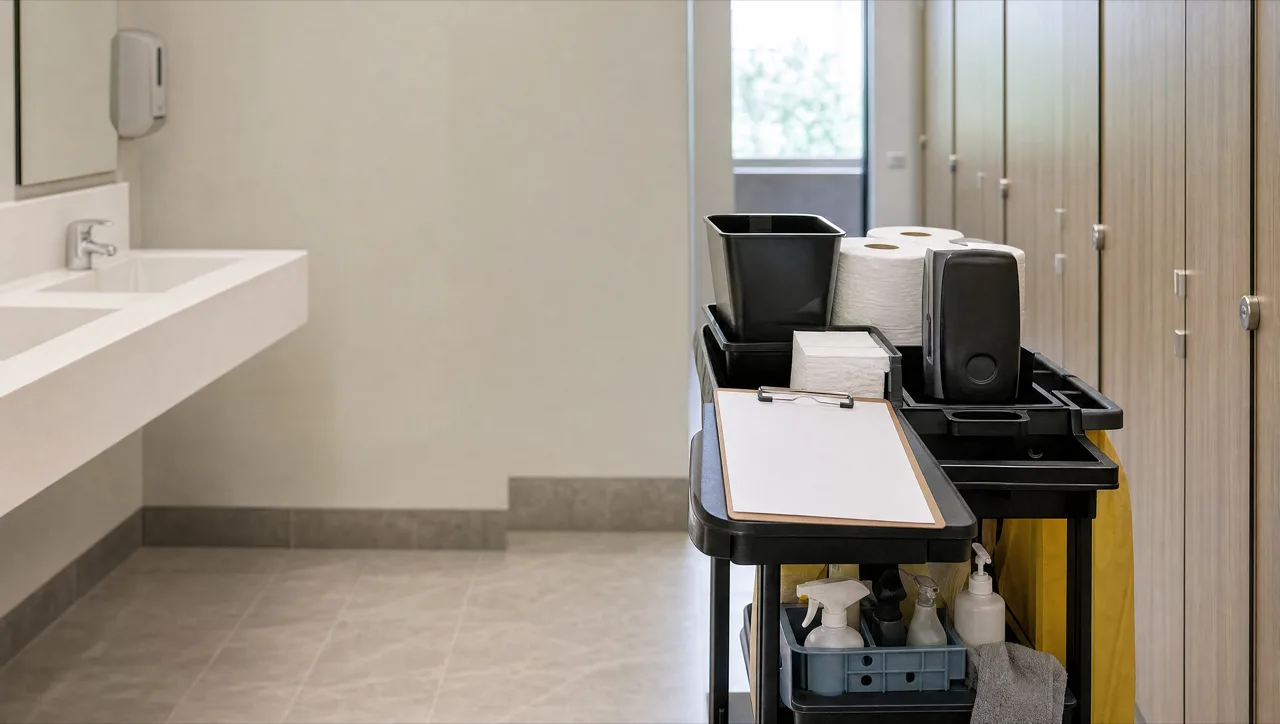
A run-out is a service failure that announces itself to every washroom user. The fix isn't more visits. It's matching capacity and frequency to how each washroom actually gets used.
Key takeaways
- Run-outs cluster on predictable spike days; averages hide exactly those days.
- Refill to full, and set intervals so no dispenser drops below one-third before the next visit.
- Main-floor and event-adjacent washrooms need double headroom; accessible rooms carry compliance weight.
- Revisit cadence on any run-out, two light visits in a row, or any population change.
Start from capacity, not frequency. A dual-column dispenser holds ~40 units. If a washroom sees 30 uses a week, a monthly visit leaves headroom; at 120 uses a week, no schedule saves an undersized unit. Upsize first, then set frequency.
Log fill levels, not just visits. A visit that finds the column 80% full is a signal to stretch the cycle; one that finds it empty is a signal you already failed. The fill level at service time is the single most useful number in the program.
Respect weekly rhythm. Hybrid offices peak Tuesday–Thursday; gyms peak evenings and January; campuses die in May. Schedules that ignore rhythm either overpay or run out, usually both, in different rooms.
Two months of data beats any estimate. We set a starting schedule from facility type, then re-tune every washroom after eight weeks of logged fills. The result is almost never the schedule anyone guessed at the start.
Why run-outs cluster instead of spreading
Run-outs are not random. They cluster on predictable days. The Tuesday after a long weekend, the first cold week of September when campus traffic returns, the Monday a conference lands in the building. A restocking schedule built on average consumption misses every one of those days, because averages flatten exactly the spikes that empty a dispenser. The fix is not more frequent visits everywhere; it is knowing which washrooms spike and padding those, while quiet washrooms keep a longer cadence.
Building the baseline
The first two months of a restocking contract are a measurement period whether anyone calls them that or not. Each visit logs what was refilled, and by visit four the per-washroom pattern is visible: which locations burn through stock, which barely move, and how much headroom each dispenser needs to survive its worst realistic week. From there the schedule stops being a guess.
- High-traffic washrooms — main-floor and near-elevator locations typically need double the stock of the same-size washroom two floors up.
- Event-adjacent washrooms — anything near a conference room or gym studio needs headroom for bookings, not headcount.
- Low-traffic washrooms — accessible and single-occupancy rooms often go weeks between refills but can never be allowed to sit empty; they carry compliance weight out of proportion to their volume.
The refill-level rule that prevents most run-outs
Refill to full at every visit and set the visit interval so no dispenser is projected below one-third full at the next visit. That one-third buffer is what absorbs the spike days. Sites that run leaner buffers save almost nothing. The product is the cheap part. And buy themselves the exact complaint the program exists to prevent. An empty dispenser in a workplace that advertises free products reads as a broken promise, and people remember it longer than they remember the months it worked.
Stock-outs cost trust, not just product. The dispenser that is always full is the one nobody thinks about. Which is the goal.
When to change the schedule
Three triggers justify a cadence change: a logged run-out (tighten immediately, ask questions after), two consecutive visits above 80 per cent remaining (loosen one step and bank the savings), and any change in the building's population, new tenant, new gym, return-to-office mandate, semester start. The schedule is a living thing tied to occupancy; a schedule nobody has revisited in a year is almost certainly wrong in at least one washroom.
The portfolio view
Across multiple buildings, restocking stops being a per-washroom question and becomes a routing question. The washrooms that spike together. Every office tower's Monday morning, every gym's January, can be scheduled together, and a route built around shared spike patterns holds buffers where they are needed the same week they are needed. This is the quiet advantage of a supplier running many sites: their route data shows the traffic patterns your single building cannot see coming. A new tenant type in your building has a usage curve someone else's building already measured.
The administrative side compounds the same way. One restocking contract with per-site logs means the quarterly review. Which washrooms tightened, which loosened, what consumption did per site, is one report, not a folder of guesses. Facilities teams inheriting a portfolio mid-year consistently report the same discovery: the sites with logged restocking histories can be managed from the desk, and the sites without them require a site visit just to learn what normal looks like. The log is not overhead on the program; for anyone who was not there when it started, the log is the program.
Frequently asked
On a dense urban route, an off-schedule top-up typically lands within one or two business days. The site is already between forty other stops. The better answer is prevention: a logged run-out automatically tightens that washroom's cadence one step, so the same gap does not open twice.
No. Logged fill levels at each scheduled visit produce a reliable per-washroom pattern within four visits. Sensors add cost and a maintenance surface; a disciplined service log gets the same schedule quality for a building of almost any size.